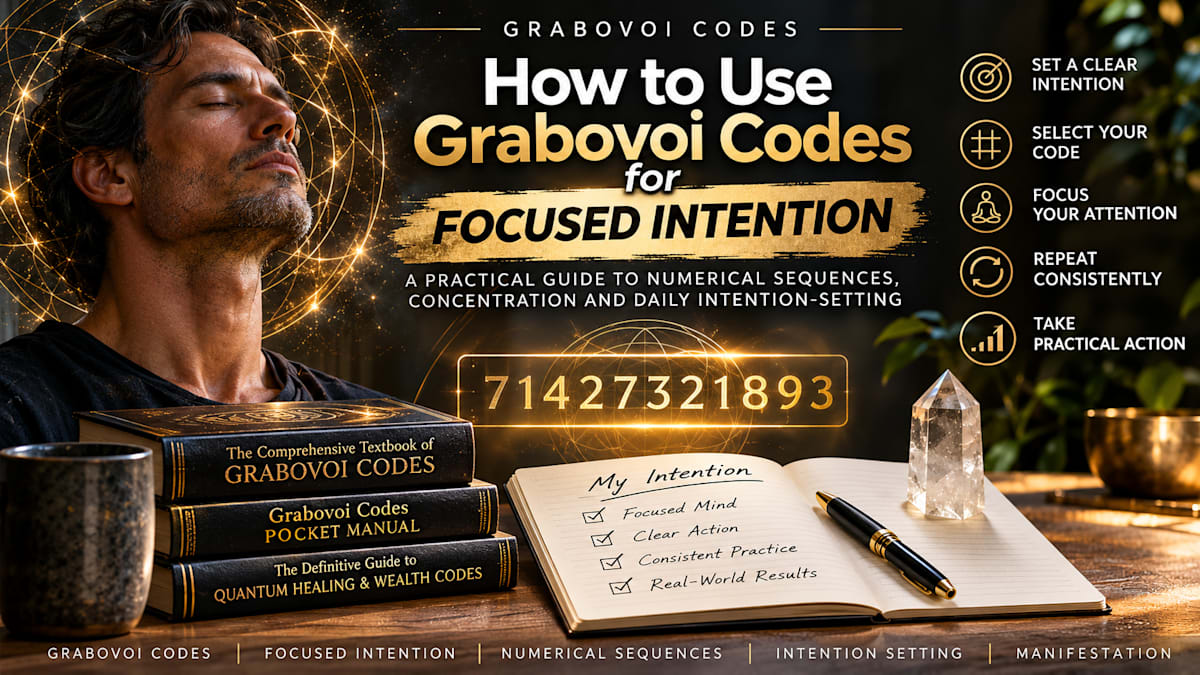
How to Use Grabovoi Codes for Focused Intention
A practical guide to using numerical sequences, focused attention and daily intention-setting
There is a difference between wanting something to happen and deliberately directing your attention towards making it happen.
Most people spend a surprising amount of time thinking about what they don't want. They worry about money, health, relationships, work and the uncertainty of what comes next. Their attention moves from one concern to another, often without any clear direction.
Focused intention offers a different approach.
Instead of allowing attention to wander, it involves choosing a specific objective and returning your thoughts to it with consistency.
One method that has attracted considerable interest within alternative personal development practices is the use of Grabovoi codes. These numerical sequences are associated with the teachings of Grigori Grabovoi and are used by practitioners as symbolic tools for directing attention towards particular intentions.
But how do you actually use them?
And more importantly, how can you incorporate them into a routine that is practical, consistent and meaningful?
Let's look at the process.
What Are Grabovoi Codes?
Grabovoi codes are numerical sequences associated with specific intentions or desired outcomes.
They are commonly used in areas such as:
- Health and personal wellbeing
- Financial stability and abundance
- Emotional balance
- Relationships
- Mental clarity and concentration
- Personal development
- General life circumstances
The underlying practice involves selecting a numerical sequence, concentrating on it and associating it with a clearly defined intention.
For example, someone working towards greater financial stability might select a sequence traditionally associated with financial circumstances.
The sequence becomes a point of reference for their attention.
It is important to understand that there is no established scientific evidence demonstrating that Grabovoi numerical sequences independently produce physical, financial or external changes. Their practical value can instead be explored as tools for concentration, reflection, repetition and intentional behaviour.
This distinction matters. You do not need to accept extraordinary claims to experiment with a structured attention practice.
Why Focused Intention Matters
Think about how easily your attention can become divided.
You might start the morning thinking about an important goal. Within minutes, you're checking messages, responding to problems and thinking about several unrelated things.
By the afternoon, the original intention has disappeared beneath a collection of distractions.
This is where a structured practice can be useful.
Focused intention gives your mind a specific subject to return to. Rather than repeatedly thinking about a general desire, you identify what you want to work towards and give it deliberate attention.
Three elements are particularly important:
1. Clarity
You need to know what you are directing your attention towards.
2. Consistency
Repeatedly returning to an intention helps establish a more deliberate mental routine.
3. Action
An intention becomes more useful when it influences your decisions and behaviour.
Grabovoi codes can be incorporated into this process as a symbolic focal point.
Step 1: Choose One Clear Intention
Before selecting a numerical sequence, decide what you want to focus on.
Avoid starting with several unrelated objectives.
For example, instead of saying:
"I want everything in my life to improve."
Choose something more specific:
- I want to develop greater financial stability.
- I want to improve my concentration.
- I want to establish healthier daily habits.
- I want to approach difficult situations with greater emotional control.
- I want to make progress towards a particular personal goal.
Specific intentions are easier to revisit and translate into practical decisions.
There is also a useful distinction between focusing on an outcome and focusing on the behaviour that supports it.
For example, wanting financial stability is an outcome. Reviewing your spending, improving your skills and creating additional income opportunities are behaviours that can move you towards it.
Both deserve attention.
Step 2: Select an Appropriate Grabovoi Code
Once you have established your intention, identify a numerical sequence traditionally associated with that area.
Use a reliable reference source rather than selecting random numbers or assuming that every sequence has the same meaning.
For beginners, I recommend working with one sequence at a time.
This keeps the process straightforward and makes it easier to maintain concentration.
Write the selected sequence somewhere accessible.
You might use:
- A notebook.
- A printed reference card.
- A note on your phone.
- A dedicated daily intention journal.
- A quiet space where you practise concentration.
The objective is to create a consistent reference point.
Step 3: Establish Your Focus
Find a quiet place where you can spend a few uninterrupted minutes.
Sit comfortably and take a few slow breaths.
Allow your attention to settle before introducing the numerical sequence.
Look at the numbers and read them slowly.
You can repeat the sequence silently or mentally visualise each digit.
There is no requirement to force concentration or achieve a particular mental state.
If your attention wanders, simply return to the sequence.
The exercise is about deliberate attention, not perfection.
A useful starting point is three to five minutes.
You can increase the duration if you find the practice beneficial.
Step 4: Connect the Sequence to Your Intention
This is the central part of the exercise.
Rather than concentrating on numbers without context, associate the sequence with the intention you selected.
For example, if your intention concerns financial stability, spend a moment considering what financial stability actually means to you.
It might involve:
- Having greater control over your finances.
- Reducing unnecessary spending.
- Developing a reliable income source.
- Building savings.
- Making more considered financial decisions.
As you concentrate on your selected sequence, bring your attention back to this objective.
You can use a short written statement:
"My intention is to develop greater financial stability through clear decisions, consistent action and disciplined behaviour."
Read the statement slowly.
Then return your attention to the numerical sequence.
This creates a simple relationship between the number, the intention and the practical outcome you are working towards.
Step 5: Repeat the Practice Consistently
Consistency is more useful than occasional lengthy sessions.
A simple daily routine is often enough to begin exploring the practice.
You could use the following structure:
Morning
Spend three to five minutes reviewing your intention and concentrating on your selected sequence.
During the day
When you encounter a distraction or lose focus, briefly recall your intention.
You do not need to repeat the entire exercise.
Evening
Spend a few minutes reviewing your progress.
Ask yourself:
- Did I remain focused on my objective?
- Did my decisions reflect my intention?
- What could I improve tomorrow?
This final step is particularly important.
It connects the mental exercise to observable behaviour rather than allowing the practice to become an activity that exists separately from everyday life.
Step 6: Keep a Record of Your Progress
A simple intention journal can help you understand how the practice affects your concentration and behaviour.
Create three columns:
DateIntentionPractical action
Monday | Financial stability | Reviewed weekly expenses
Tuesday | Mental clarity | Completed an important task without distractions
Wednesday | Emotional balance | Responded calmly to a difficult situation
Thursday | Personal development | Spent 30 minutes learning a new skill
You can also record the numerical sequence you are using.
Over time, this creates a record of your practice and makes it easier to identify whether your routine is helping you stay focused.
The important measurement is not whether a number has magically changed your circumstances.
It is whether the practice is helping you become more deliberate about your thoughts, decisions and actions.
A Simple Five-Minute Grabovoi Intention Exercise
If you are new to Grabovoi codes, try this basic routine.
Minute 1: Settle
Sit quietly and take several comfortable breaths.
Minute 2: Define
Read your chosen intention. Make sure it is specific and meaningful.
Minute 3: Concentrate
Look at your selected numerical sequence. Read it slowly and direct your attention towards it.
Minute 4: Visualise
Picture yourself taking practical steps towards your objective. Focus on the process rather than simply imagining the final result.
Minute 5: Commit
Identify one action you can take today that supports your intention.
Finish the exercise and move on with your day.
You don't need elaborate rituals, special equipment or complicated techniques.
The value lies in having a repeatable process.
Common Mistakes When Using Grabovoi Codes
There are several mistakes that can make the practice less useful.
1. Trying to Work With Too Many Codes
Using ten different sequences for ten different objectives can make it difficult to maintain a clear focus.
Start with one intention and one sequence.
2. Constantly Changing Your Intention
Give yourself enough time to explore one objective before moving to another.
Changing direction every day can turn the practice into a search for something new rather than an opportunity to develop consistency.
3. Treating Numbers as a Replacement for Action
This is probably the most important point.
Concentrating on a numerical sequence will not replace medical treatment, financial planning, professional advice or the practical work required to achieve a goal.
Use the practice alongside sensible decisions and real-world action.
4. Expecting Immediate Results
There is no scientifically established timeframe in which Grabovoi codes produce a particular result.
Avoid setting arbitrary deadlines or interpreting every coincidence as proof that a sequence has worked.
Give the practice room to develop without abandoning common sense.
5. Losing Sight of the Original Intention
The numerical sequence is a focal point. The intention is the reason you selected it.
Keep returning to the original objective.
Can Grabovoi Codes Be Combined With Other Intention Techniques?
Yes. Many people who explore numerical sequences also experiment with other concentration and personal development methods.
Some complementary approaches include:
Written intentions
Writing down a clearly defined objective can help turn a vague desire into something more concrete.
Visualisation
Mentally rehearsing a task or desired behaviour can help you prepare for taking action.
Meditation
A regular meditation practice can provide an opportunity to observe distractions and develop attentional awareness.
Affirmations
Short, realistic statements can reinforce the behaviour and mindset you want to develop.
Goal tracking
Recording measurable progress helps connect intention with practical results.
These approaches do not need to compete with one another.
They can form part of a broader personal routine, provided you understand what each technique can and cannot reasonably achieve.
Final Thoughts: Give Your Attention a Direction
The interesting thing about focused intention is that it begins with a simple decision.
You decide what matters, direct your attention towards it and make a conscious effort to act accordingly.
Grabovoi codes offer one particular framework for people interested in numerical sequences and structured intention practices.
Whether you approach them from a spiritual perspective, as a concentration exercise or simply as an experiment in personal discipline, the most useful starting point is the same.
Choose an intention.
Work with one sequence.
Establish a consistent routine.
And make sure your daily actions support the objective you have chosen.
Numbers alone are not a substitute for action. But a deliberate practice that reminds you what you are working towards can become a useful part of how you organise your attention and approach your goals.
Your attention is a limited resource. Where you direct it, and what you do with it afterwards, matters.
Explore More Grabovoi Codes
If you want to explore numerical sequences in greater detail, Hutchinson Publications has developed a collection of practical reference books covering Grabovoi codes, their traditional associations and their use in structured daily practices.
Explore:
- The Comprehensive Textbook of Grabovoi Codes
- Grabovoi Codes Pocket Manual: 1100 Practical Codes
- The Definitive Guide to Quantum Healing & Wealth Codes
Explore the collection and find a reference guide to support your own intention-setting practice.
Hutchinson Publications | Practical Guides to Numerical Sequences, Consciousness and Personal Development