Manifestation is often presented as a simple formula.
Think about what you want.
Visualise it.
Feel it.
Repeat it.
Wait for it to appear.
But there is a problem with that approach.
It assumes your attention is working in one direction.
Most of the time, it isn't.
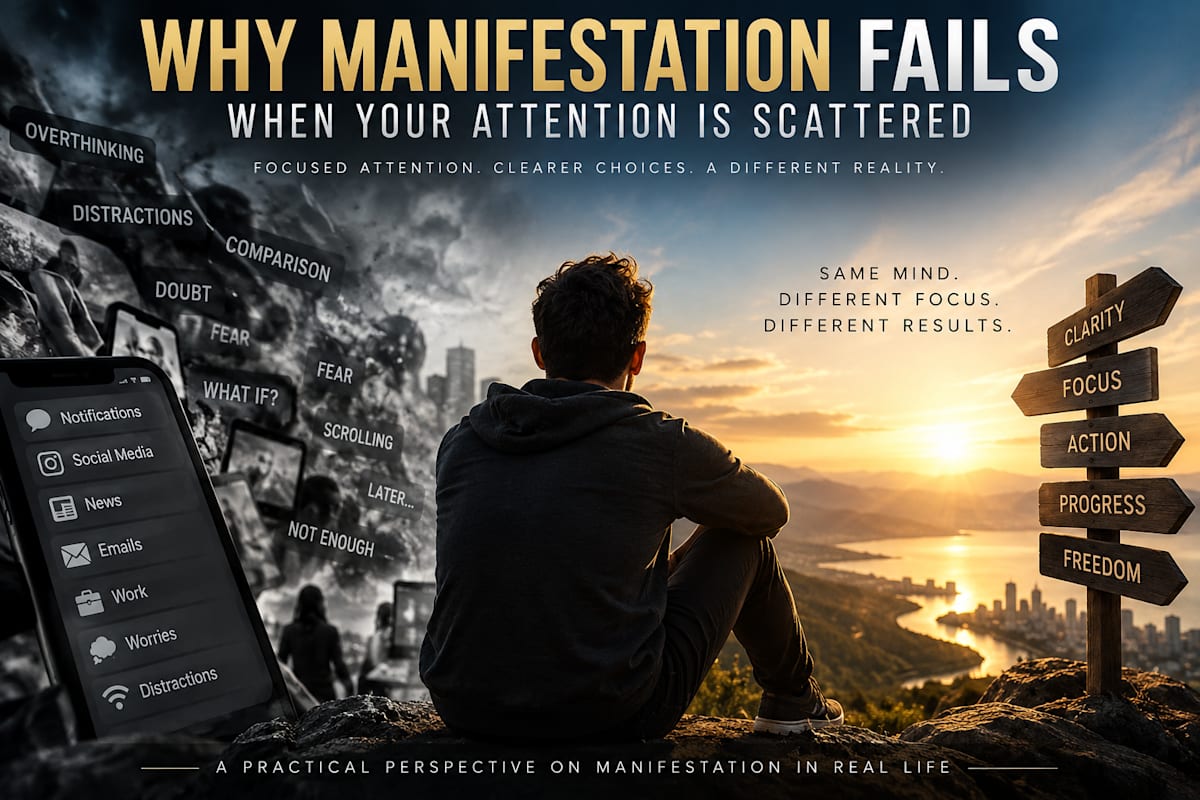
You might spend ten minutes visualising financial freedom in the morning, then spend the next eight hours worrying about bills, checking your bank balance, scrolling through other people's lives, jumping between tasks and reacting to whatever notification appears on your phone.
That's a very different signal.
And this is where the idea of manifestation becomes more interesting.
Your attention is doing more work than you realise
Every day, your attention is being pulled in dozens of directions.
Messages.
News.
Social media.
Work.
Money.
Relationships.
Problems.
Plans.
Notifications.
Random thoughts that appear out of nowhere.
The human brain is remarkably good at responding to whatever demands its attention.
The problem is that it doesn't always distinguish between what is important and what is simply loud.
A notification is loud.
A long-term goal usually isn't.
This matters because repeated attention influences what you notice, what you remember, what you practise and, eventually, what you do.
If your attention is constantly scattered, your behaviour tends to become scattered as well.
And behaviour is where intentions eventually meet reality.
Manifestation without action is an incomplete system
You can visualise becoming financially independent.
But if you never look at your finances, nothing changes.
You can imagine becoming confident.
But if you continually avoid difficult conversations, the underlying pattern remains.
You can visualise writing a book.
But eventually, somebody has to sit down and write the first page.
This doesn't mean visualisation is useless.
It means visualisation works best when it is connected to behaviour.
Your internal picture gives your attention a direction.
Your actions give that direction somewhere to go.
That distinction gets lost in a lot of manifestation advice.
The real question is: what are you repeatedly rehearsing?
Consider two people who both want the same outcome.
Person A spends five minutes each morning focusing on the outcome.
Then they spend the rest of the day reinforcing the opposite idea.
"I'll never have enough money."
"I'm not good enough."
"Nothing ever works for me."
"There's no point trying."
Person B also spends five minutes visualising the outcome.
But during the day, they deliberately notice opportunities related to it.
They make the phone call.
They learn the skill.
They apply for the position.
They start the project.
They review their finances.
They change the behaviour that keeps producing the result they don't want.
The difference isn't necessarily that Person B has stronger belief.
Their attention simply has somewhere to go.
Attention creates filters
Your brain cannot process everything around you.
So it filters.
You don't consciously notice every car on the road.
Every conversation.
Every advertisement.
Every sound.
Every face.
Every business opportunity.
Your attention helps determine what gets prioritised.
This creates an interesting feedback loop.
You focus on a particular subject.
You start noticing more information related to that subject.
That information creates new ideas.
Those ideas influence your decisions.
Your decisions produce new experiences.
Those experiences reinforce what you are paying attention to.
Over time, a small shift in attention can create a much larger shift in behaviour.
This is one reason focused intention can be useful even if you completely remove the supernatural claims sometimes attached to manifestation.
You don't need to believe that the universe is delivering packages to your front door because you visualised them.
You can simply recognise that what you repeatedly focus on influences what you notice and what you do next.
That's already powerful enough.
Try the 10-minute attention test
Here's a simple experiment.
Choose one outcome you genuinely want to improve.
Don't choose ten.
Choose one.
For the next seven days, spend ten minutes each morning writing about it.
Ask yourself:
What exactly do I want?
Why does it matter?
What would change if I achieved it?
What behaviour would the person who achieved it be doing today?
Then choose one action.
Something small enough that you will actually do it.
Not tomorrow.
Today.
The purpose isn't to sit around waiting for something to magically appear.
The purpose is to train your attention to recognise the relationship between intention and action.
At the end of the seven days, look back.
Did you notice different opportunities?
Did you make different decisions?
Did you behave differently?
Did anything change?
That is far more useful information than simply asking whether you "manifested" the outcome.
The overlooked part of manifestation
I think the most interesting part of manifestation isn't whether thoughts can magically rearrange external reality.
It's what happens when a person becomes extremely deliberate about where their attention goes.
That changes the questions they ask.
It changes what they notice.
It changes what they practise.
And repeated practice changes capability.
Capability changes behaviour.
Behaviour changes results.
The chain is surprisingly ordinary.
But ordinary doesn't mean insignificant.
Your attention is a limited resource
You only have so much attention available each day.
Spend it carelessly and your goals have to compete with everything else.
Spend it deliberately and you create a different operating environment for yourself.
That doesn't guarantee that you'll get everything you want.
Life doesn't work that neatly.
But it does increase the likelihood that your thoughts, decisions and actions are pulling in the same direction.
And that is probably a more useful definition of manifestation than simply wishing harder.
Choose the direction.
Hold the attention.
Take the action.
Then watch what changes.